Trading journal examples: what to write after every trade
The hardest part of a trading journal isn’t the numbers. It’s knowing what to write. Here are four examples in the exact format I’d use: a good win, a good loss, a bad win and a weekly review. Notice that the result isn’t what makes a trade good or bad.
Example 1: a good win
Setup: Asian range sweep · Grade: A+
Entry 2320.40 · stop 2322.90 · target 2314.00 (2.6R) · risk £100 (1%)
Result: target hit, +2.56R, +£256 · Followed plan: yes
Why: ran the Asian high, closed back inside, M5 structure shift.
Lesson: waiting for the close kept me out of the first spike. Keep doing that.
Example 2: a good loss
Setup: liquidity sweep · Grade: B
Entry 1.32150 · stop 1.32050 · target 1.32400 (2.5R) · risk £100 (1%)
Result: stopped out, −1R, −£100 · Followed plan: yes
Why: swept the London low with the H1 trend.
Lesson: US data was due 30 minutes later. Check the calendar first; skip setups within an hour of red-folder news.
This is a good trade. The plan was followed and the risk was right. Losses like this are the cost of doing business.
Example 3: a bad win
Setup: trend pullback (loosely) · Grade: C
Entry 20150 · stop 20120 · exit 20180 · risk £50
Result: +1R, +£50 · Followed plan: no
Why: honestly, boredom. Nothing had set up all day.
Lesson: a win that breaks the plan teaches the wrong habit. New rule: no trades after 15:00 UK.
This is the most dangerous entry in the journal. It made money, so it feels fine. Repeat it 20 times and it will cost you far more than it made.
Example 4: the weekly review
Best setup: Asian range sweep, 3 trades, +4.6R · Worst: trend pullback, 2 trades, −1.5R
London: +5.2R · New York: −1.1R (two trades near US data)
Followed plan: 7 of 9. The two that broke it: −0.5R combined.
One change for next week: no New York trades within an hour of high-impact US data.
The five questions to answer for every trade
- Which setup was it, and how did I grade it before entry?
- Was it in my planned session or kill zone?
- Did I risk what my plan says, with the stop where the setup says?
- Did I follow the plan from entry to exit?
- What’s the one lesson, in one line?
Keep it short. Two lines of honest notes beat a page you’ll stop writing after a week.
Make it quick, or you won’t keep it up
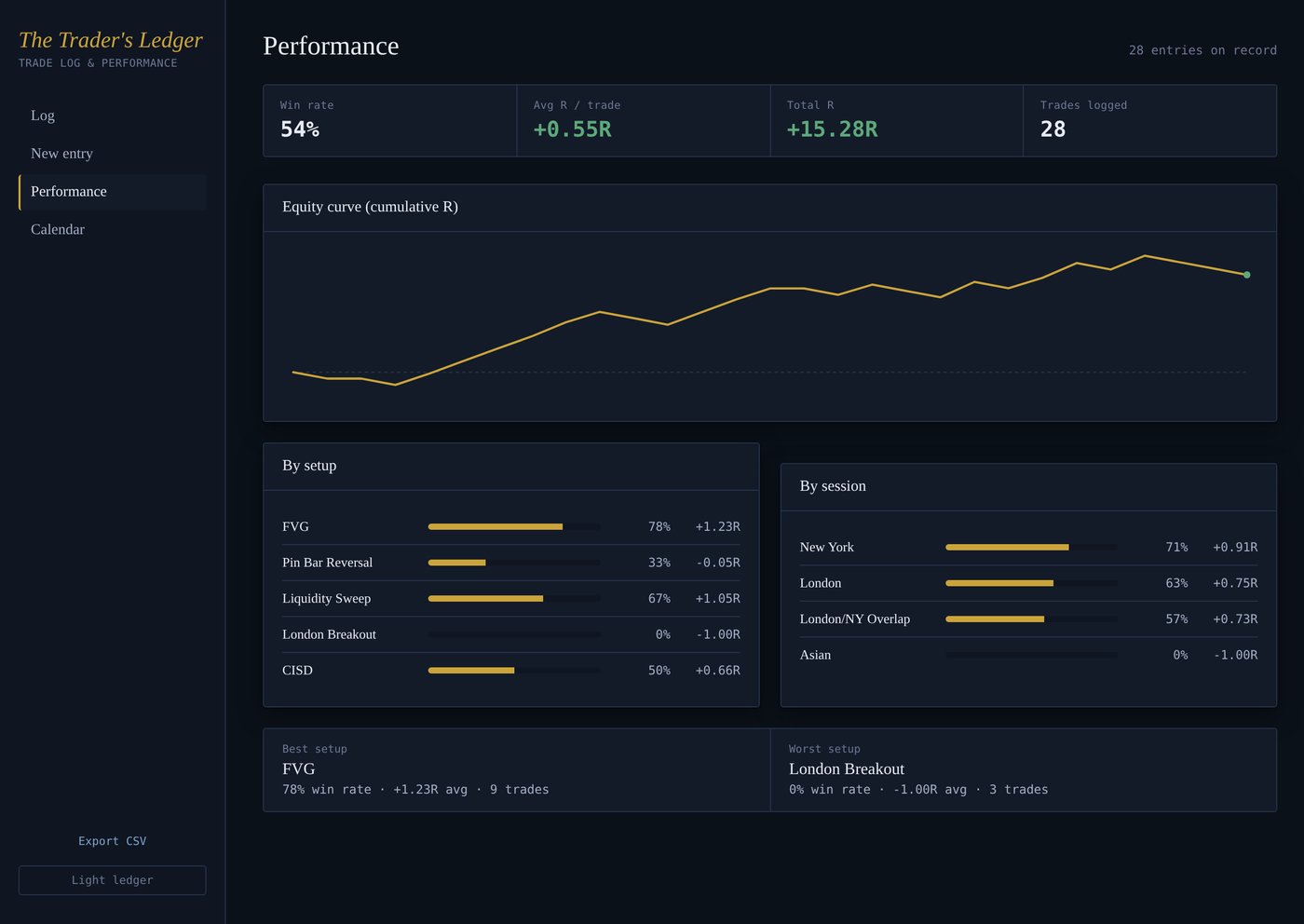
All four examples fit the free trading journal template. Or use The Trader’s Ledger, which asks the five questions for you: pick the setup, tick the pre-trade check (it grades the trade A+ to Skip), type the prices, and add your note. It takes about a minute, and the weekly review is drawn for you.
Journal every trade in about a minute
The Trader’s Ledger runs in your browser with nothing to install: 25 written setup cards, a pre-trade check that grades every trade A+ to Skip, lot sizes worked out for you, your stats by setup and session, and a free 49-page trading course. £19 once, the launch price until 31 December 2026, with a 14-day money-back guarantee.
See The Trader’s LedgerFrequently asked questions
What should I write in my trading journal?
For each trade: the setup and its grade, the session, entry, stop, target and exit, the risk, the result in R, whether you followed your plan, why you took it and one lesson.
What is a good trading journal entry?
Short and honest. The key facts of the trade, whether it followed the plan, and one line on what to keep doing or change. A loss that followed the plan is a good entry.
How long should a trading journal entry be?
A few lines. If journaling takes longer than a couple of minutes per trade, most traders stop doing it.
Should I journal losing trades?
Yes, every one. Your losses, and especially the trades that broke your rules, are where the biggest improvements come from.
Educational content only, not financial advice. Trading carries a high level of risk and you can lose more than you expect. Examples use illustrative prices.