The best trading journal in 2026: an honest guide (and why you shouldn’t pay monthly for one)
The best trading journal is the one you’ll still be filling in six months from now. Not the one with the most AI features, the most broker integrations or the slickest dashboard. The one you actually use, every trade, without fail.
That sounds obvious. But search “best trading journal” and you’ll find page after page of comparisons written by the journal companies themselves, each one quietly crowning its own product the winner. Almost all of them charge every month, in US dollars, for as long as you trade.
This guide is different. I’m a UK trader who trades forex and gold on MetaTrader, and I spent the early 1990s designing software before a long career running my own businesses. I built a trading journal because I wanted one I’d actually use, and that I’d only pay for once. Below I’ll walk you through what genuinely matters in a journal, how the big names compare on price, and which option suits which kind of trader, including when mine isn’t the right choice.
What actually makes the best trading journal?
Strip away the marketing and a good trading journal does five things well.
- It’s quick to fill in. If logging a trade takes longer than a minute, you’ll stop doing it after a bad week. Bad weeks are exactly when you need the journal most.
- It records the why, not just the numbers. Entry, exit and profit are in your broker statement already. What isn’t there is your reason for taking the trade, which setup it was, and how you felt. That’s where your edge, and your leaks, are hiding.
- It shows you patterns. Which setups make you money? Which sessions? Which days? A journal should turn a pile of trades into a few clear answers.
- It holds you to your rules. The real value of journaling is discipline. Seeing “broke my rules” next to your three biggest losses changes behaviour faster than any indicator.
- It fits how you trade. A US stock day trader and a UK forex swing trader need different things. More features isn’t better; the right features are.
Notice what’s not on the list: AI chatbots, 500 broker integrations, social leaderboards. Nice to have, perhaps. But none of them will make you a consistent trader if you don’t sit down and review your trades honestly. (New to journaling? Start with how to keep a trading journal.)
The big names compared (and the subscription problem)
The best-known journals are genuinely good products. The catch is what they cost over the years you’ll be trading.
| Journal | Best known for | Price (as listed, Oct 2026) | Cost over 3 years |
|---|---|---|---|
| TraderSync | Broad broker coverage, AI coach | Full AI features on Elite, $79.95/month | about $2,878 |
| Tradervue | Veteran journal, free tier | Limited free plan, paid from $29.95/month | about $1,078 |
| TradeZella | Analytics, trade replay | From $35/month, or $26/month billed yearly | about $936 |
| Edgewonk | Psychology tracking | $197 per year | about $591 |
| Stonk Journal | Free, manual entry | Free | $0 |
| The Trader’s Ledger | UK-built, forex and gold | £19 once (launch price until 31 December 2026, then £39) | £19 |
US dollar prices are each company’s listed pricing as reported in October 2026; they change often, so check before you buy. Three-year cost assumes the cheapest listed way to pay for that tier.
TraderSync is the most feature-packed of the group, and the most expensive. StockBrokers.com called it by far the priciest journal in its roundup. It suits high-volume US day traders and options traders who want everything synced automatically.
Tradervue has been around since 2011 and is a solid, no-nonsense choice, especially for US stock traders. Its free plan caps how many trades you can log each month.
TradeZella is the most heavily marketed journal in the space, with excellent analytics, trade replay and backtesting. If you want deep post-trade analysis and don’t mind paying monthly, it’s a strong pick.
Edgewonk is the best value of the subscription journals. It charges one yearly fee and leans into trading psychology, which is where most traders actually lose money.
Stonk Journal is free and genuinely useful for building the habit. The trade-off is manual entry and no broker sync.
Want the deeper feature-by-feature breakdown? See the best trading journal for professional traders.
The best trading journal for forex and gold traders on MT4/MT5
Most “best trading journal” lists are written for US stock and options traders. If you trade forex or gold (XAUUSD) on MetaTrader 4 or 5, your needs are different, and most roundups give you a single line at best. As a forex or gold trader, your journal needs to handle:
- Sessions. Your results almost certainly differ between the Asian, London and New York sessions. A good journal makes it obvious which one is paying you and which one is costing you. (See forex market hours in UK time.)
- Setups, not tickers. You might trade the same five pairs every week. What changes is the setup: a liquidity sweep, a London breakout, a New York reversal. Tagging trades by setup is where the insight is.
- Risk in R, not just pounds. Gold moves fast and lot sizes vary. Measuring every trade in R (multiples of what you risked) is the only fair way to compare a winning week on gold with a winning week on EUR/USD. (More in risk to reward explained.)
- Rules and mindset. Revenge trading after a stop-out on gold can wipe out a week in an hour. Your journal should make broken rules impossible to ignore.
There are specialist forex journals that sync directly with MetaTrader, such as Swift Journal, though it’s forex-only and has no free trial. Most of the big subscription journals also connect to MT4/MT5. Auto-sync is convenient, but it comes with an ongoing fee and your trade history living on someone else’s servers. Many traders find that typing in the trade, and the reason for it, is itself part of the discipline.
The Trader’s Ledger: a journal you buy once
The Trader’s Ledger is the journal I built for exactly the trader described above, and the one I use for my own trading. It’s designed around one idea: Where Excellence Meets Discipline.
What you get for a one-off £19 (launch price until 31 December 2026, then £39)
- No subscription, ever. Pay once, use it for as long as you trade. No monthly fee creeping up, no renewal reminders.
- Your data stays on your device. The Ledger runs in your browser with no account or login, and your trades are saved locally, not on anyone’s server. Export everything to CSV whenever you like.
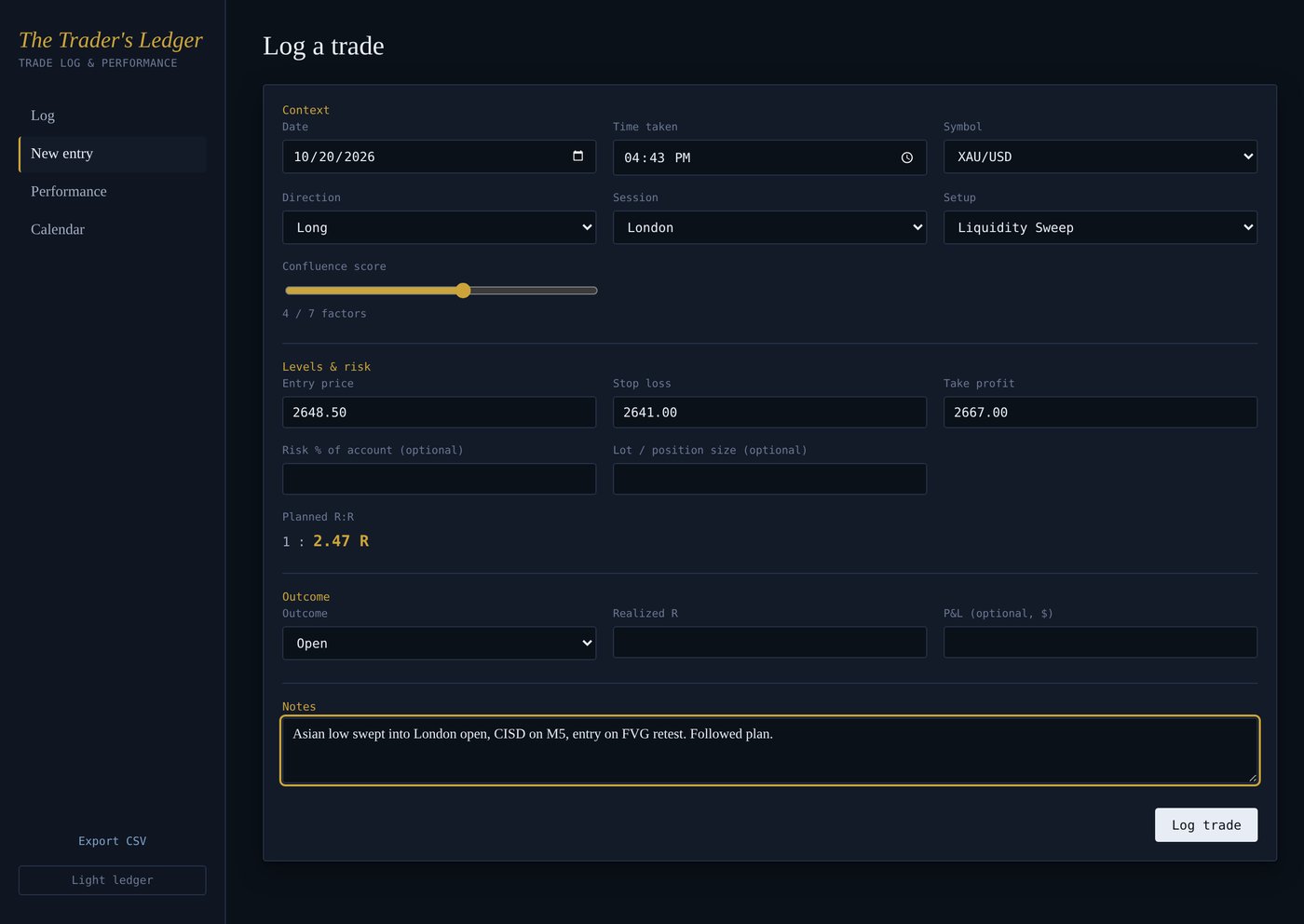
- Built for forex and gold. Log every trade with its pair, session, setup, confluence score and notes. Your planned risk:reward is calculated for you.
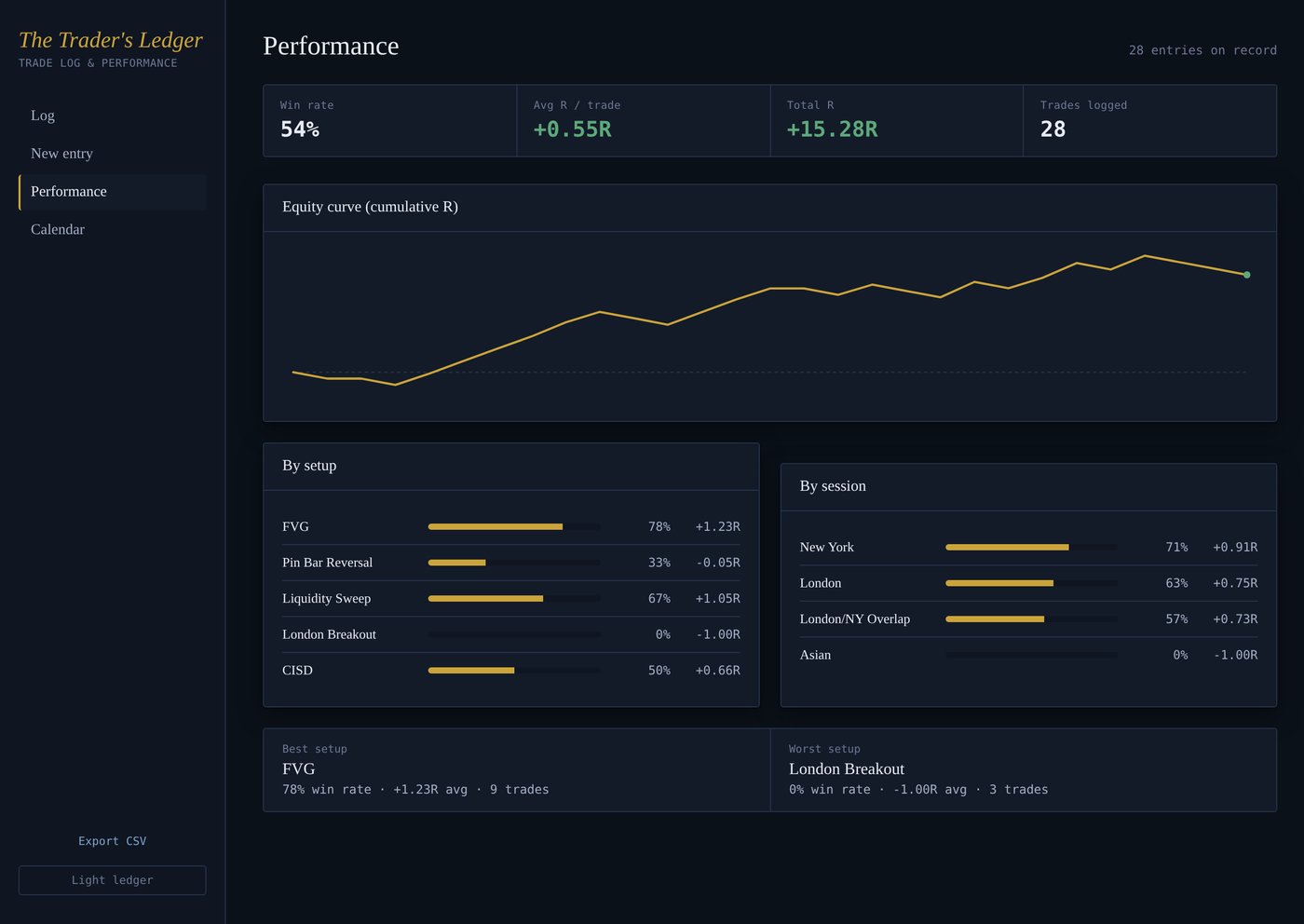
- Performance you can act on. Win rate, average R and total R, an equity curve, and results broken down by setup and by session, with your best and worst setup highlighted.
- A calendar with a daily loss limit. See every winning and losing day at a glance, with days that broke your loss limit flagged.
- 25 rule-based trading setups included. Not vague ideas: defined, rule-based setups you can log against and test in your own journal.
- A full 49-page trading course, free. From beginner to advanced, with diagrams, included with your purchase.
- A private members’ community. Every buyer gets free access to The Trader’s Ledger members’ group on Facebook.
Add TTL Volume Profile Pro: see where the market really traded
A journal tells you what you did. TTL Volume Profile Pro shows you why price reacted where it did. It’s an automatic fixed-range volume profile indicator for MT4 and MT5, and it’s the tool I keep on every chart alongside the Ledger. (New to it? Read volume profile explained.)
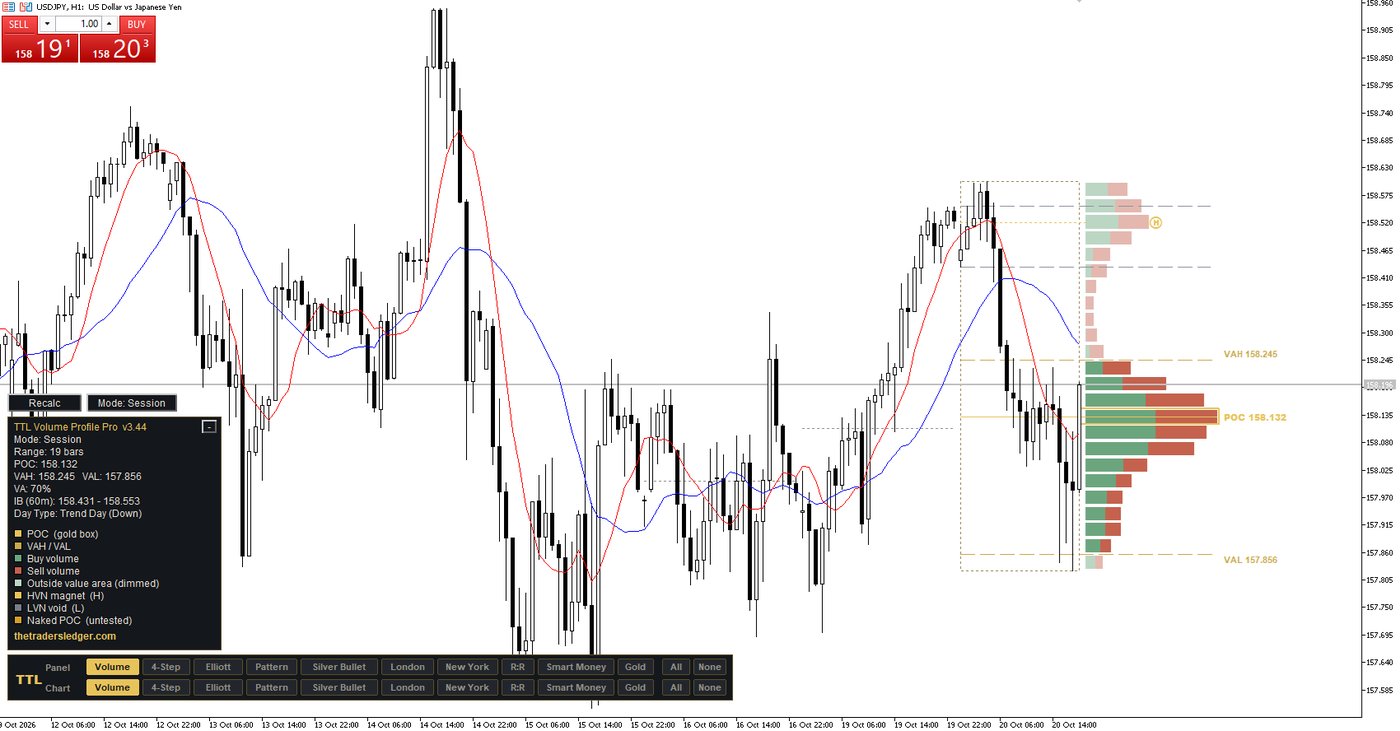
- Automatic anchoring. Anchor to Auto Swing, Fixed Bars, Session or Week and the profile draws itself over the range that matters, with no manual dragging. Alerts fire when price reaches the POC, VAH or VAL.
- High- and low-volume nodes (HVN/LVN). See instantly where the market accepted price and where it rushed through, plus naked POCs that price hasn’t yet returned to. Those levels make clean entries, stops and targets.
- Volume delta. Gauge whether buyers or sellers were in control inside the range.
- Initial balance and day type. Read the opening range and the type of day forming, so you know whether to expect a trend or a rotation.
- Matching style and a full PDF user guide. Designed in the same look as the Ledger, with step-by-step instructions.
On forex and gold, MetaTrader uses your broker’s tick volume rather than central exchange volume. In practice it tracks activity closely enough to mark the levels that matter, which is what the profile is for.
How it works with the Ledger: tag each trade with the profile level it came from (HVN rejection, LVN break, initial balance breakout). After 30 or 40 trades, your journal will show you which volume setups pay you, and which to drop.
TTL Volume Profile Pro is £39, a one-off purchase, delivered as a compiled MT4/MT5 file licensed to your own trading accounts.
Launch offer: the Ledger and Volume Profile Pro together for £19
For the first 100 buyers, the bundle gives you The Trader’s Ledger, the 49-page course, the 25 setups and TTL Volume Profile Pro for MT4 and MT5, with the profiler free. One payment, no subscription.
Get the bundle for £19The rest of the TTL indicator range
The Ledger also pairs with TTL Gold Hybrid Pro, TTL 4-Step Pro, TTL Elliott Wave Pro and TTL Pattern Pro. They spot the same setups the Ledger tracks, so you can go from chart to journal with one consistent method. Every indicator is sold separately; the journal works perfectly well on its own. Browse all TTL indicators.
Who The Trader’s Ledger isn’t for
I’d rather you bought the right journal than the wrong one from me. The Ledger probably isn’t for you if:
- You take dozens of trades a day. High-frequency scalpers who need every fill imported automatically will be better served by an auto-sync journal like TraderSync or TradeZella.
- You trade mainly US stocks or options. Tradervue and TraderSync are built around those markets.
- You want AI to review your trades for you. The Ledger is deliberately hands-on. If you’d rather a chatbot told you what went wrong, a subscription AI journal is the better fit.
- You want a free-forever starter. If you’re only just testing whether journaling is for you, Stonk Journal costs nothing.
If you trade forex or gold, take a handful of quality trades a week, and want a journal you own outright, read on.
How to choose the best trading journal for you
Ask yourself these six questions before you sign up for anything.
- What do I trade? US stocks and options, or forex and gold on MetaTrader? Pick a journal built for your market.
- How many trades do I take? Under 20 a week, manual logging is quick and builds discipline. Over 20 a day, you’ll want auto-sync.
- What will it cost me over three years? Multiply the monthly fee by 36. Then decide if the extra features are worth it.
- Where does my data live? On your device, or on a company’s server you’ll lose access to if you stop paying?
- Can I tag setups and sessions? If not, you’ll never find out which setup actually makes you money.
- Will I actually use it? Be honest. A simple journal you fill in beats a powerful one you abandon.
Whichever journal you pick, pair it with a written plan: here’s a trading plan template to start from.
The bottom line
The best trading journal is the one that turns your trades into lessons, and that you’ll keep using through the losing weeks. If you’re a high-volume US stock trader, a subscription journal like TradeZella or TraderSync earns its fee. If you want psychology tools on a yearly bill, Edgewonk is excellent value.
But if you trade forex or gold, value your discipline more than a dashboard full of AI, and would rather pay once than forever, The Trader’s Ledger was built for you.
The Trader’s Ledger: £19, once
Includes 25 rule-based setups, the full 49-page trading course and free access to the members’ community. Want the levels behind your trades too? Add TTL Volume Profile Pro, or take the launch bundle above.
Get The Trader’s Ledger for £19Sources
Competitor prices and claims checked October 2026:
- StockBrokers.com: Best Trading Journals for 2026
- TradeZella: Best Trading Journals for Beginners
- Daytradingz: 10 Best Trading Journals of 2026
- Tradervue: Best Trading Journals
- CrossTrade: TraderSync Alternatives
- Tradoshi: Best Trading Journal 2026
- DayTrading.com: Swift Journal Review
Frequently asked questions
What is the best trading journal in 2026?
There’s no single best journal for everyone. TradeZella and TraderSync lead for automated analytics, Edgewonk for psychology on a yearly fee, and Stonk Journal for a free start. For UK forex and gold traders who want to pay once, The Trader’s Ledger is built specifically for that.
Is there a trading journal without a monthly subscription?
Yes. The Trader’s Ledger is a one-off purchase with no monthly fee. Edgewonk charges yearly rather than monthly, and Stonk Journal is free.
What is the best trading journal for forex traders?
Look for one that lets you tag trades by session and setup and measures results in R. Auto-sync journals such as TradeZella and Swift Journal connect to MT4/MT5; The Trader’s Ledger offers a one-off, forex-focused alternative.
What is the best volume profile indicator for MT4 and MT5?
Look for one that anchors automatically, marks high- and low-volume nodes, and shows volume delta. TTL Volume Profile Pro does all three, adds initial balance and day type, and is a one-off £39 rather than a subscription.
Is a trading journal worth it?
Yes, if you use it. Reviewing your trades is how you find out which setups make money and which habits cost you. Most traders who journal consistently discover that a small number of setups or sessions produce most of their results.
Can I just use a spreadsheet?
You can, and it’s far better than nothing. A dedicated journal saves time on the maths, keeps entries consistent, and shows patterns a spreadsheet makes you build yourself.
What should I record in a trading journal?
At minimum: the instrument, direction, entry, stop, target, exit, size, setup, session, your reason for the trade, whether you followed your rules, and how you felt.
Educational content only, not financial advice. Trading carries a high level of risk and you can lose more than you expect. Examples use illustrative prices.