The prop firm trading journal: how to pass the challenge and keep the account
Most prop firm challenges aren’t failed by bad setups. They’re failed by one bad day: a loss, a revenge trade, a bigger lot, and the daily loss limit is gone. A journal is the cheapest tool there is for stopping that day from happening.
Why prop traders need a journal more than anyone
- The rules are hard limits. Break the daily loss or maximum drawdown once and the account is gone, however good your month was.
- The pressure changes how you trade. A ticking challenge clock pushes you into trades you’d never take on your own account.
- Your edge has to be proven in R. Prop firms care about consistency. Your journal shows you, in your own numbers, whether you have it.
What to record for a prop account
| Field | Why |
|---|---|
| Risk per trade, in % of the account | Keeps every trade small enough that a losing streak can’t breach the limits. (Prop firm position sizing.) |
| Running daily P/L against the daily limit | So you know, before each trade, how much room is left. |
| Distance to maximum drawdown | The number that decides whether you keep the account. |
| Setup and grade | Only A and A+ trades on a challenge. Your journal proves which grades pay. |
| Followed plan? | The single best predictor of whether you pass. |
| Emotion before the trade | Bored, frustrated or rushing? Those trades break accounts. (How to stop revenge trading.) |
Three rules your journal should enforce
- Stop for the day at half the daily limit. If the limit is 5%, stop at 2.5%. Log it as a rule, and log every time you broke it.
- Risk no more than 0.5% to 1% per trade on a challenge. At 1%, it takes five straight losses to reach a 5% daily limit. (How much to risk per trade.)
- A+ and A trades only. Grade before you enter. If it’s a B, it’s a skip until the account is funded.
Illustrative only: (0.4 × 2.3) − (0.6 × 1) = 0.32R per trade. Real results vary and losing streaks happen.
Where to keep a prop firm journal
A free spreadsheet template works if you add your daily P/L. The Trader’s Ledger is built for the discipline side: each trade is logged against a written setup, a pre-trade check grades it A+ to Skip, with a stop and the right risk as must-haves, and the lot size is worked out for your risk on forex, gold or indices. Your results by setup, grade and session show you exactly which trades to keep for the challenge.
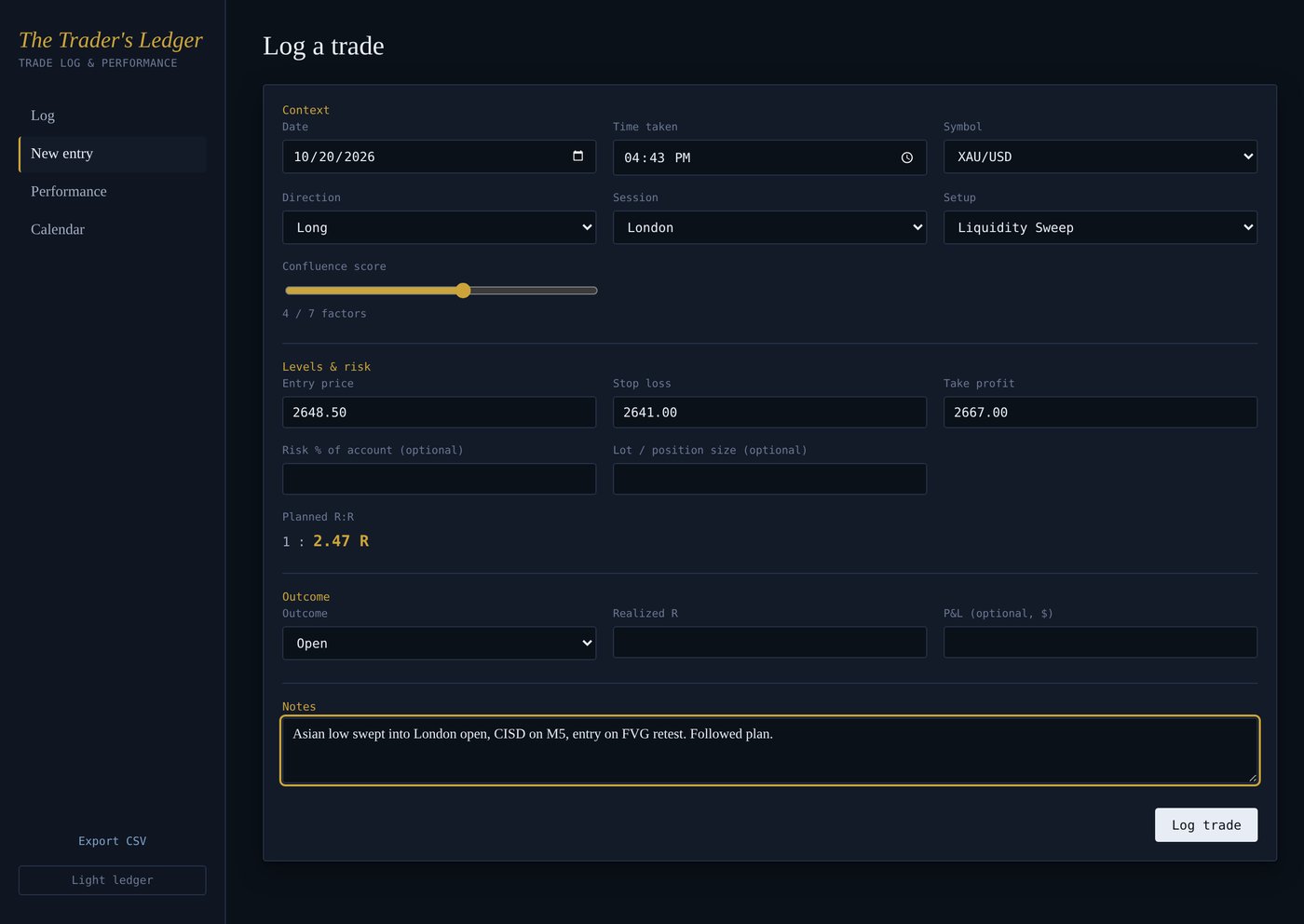
Build the discipline that keeps funded accounts
The Trader’s Ledger runs in your browser with nothing to install: 25 written setup cards, a pre-trade check that grades every trade A+ to Skip, lot sizes worked out for you, your stats by setup and session, and a free 49-page trading course. £19 once, the launch price until 31 December 2026, with a 14-day money-back guarantee.
See The Trader’s LedgerFrequently asked questions
Do I need a trading journal for a prop firm challenge?
It’s one of the best tools for passing. Most challenges are lost to rule breaks and oversized trades, and a journal makes those visible before they cost you the account.
How much should I risk per trade on a prop challenge?
Many traders use 0.5% to 1% per trade, so that a losing streak can’t reach the daily loss limit. Check your firm’s rules and size every trade from the stop.
What should a prop firm trading journal track?
Risk per trade as a percentage, running daily P/L against the daily limit, distance to maximum drawdown, setup and grade, whether you followed the plan, and your emotional state.
What is the most common reason prop firm challenges fail?
Breaking the daily loss or maximum drawdown limit, usually after a losing trade leads to revenge trading or a bigger lot size.
Educational content only, not financial advice. Trading carries a high level of risk and you can lose more than you expect. Examples use illustrative prices.