The best free trading journal options (and when it’s worth paying)
You don’t need to pay to start a trading journal. The habit matters far more than the software. Here are five free options that genuinely work, what each one is best for, and the point at which paying for a journal starts to make sense.
1. A spreadsheet template (best free all-rounder)
A good spreadsheet does most of what a paid journal does: logs the trade, works out your R and shows your stats by setup. Our free trading journal template does all of that in Excel or Google Sheets, with drop-downs for setups and sessions and a stats tab that updates itself.
Good for: anyone starting out, and anyone who likes control. Falls short: it’s easy to stop filling in, and it’s fiddly on a phone.
2. Myfxbook (best free stats for MT4 and MT5)
Myfxbook connects to your MetaTrader account, usually with your read-only investor password, and turns your history into detailed statistics: profit factor, drawdown, results by pair and time. The core analytics are free.
Good for: forex traders who want automatic statistics. Falls short: it records what happened, not why. Setups and notes depend on you tagging trades consistently, and your account data lives on its servers. More in Myfxbook alternatives.
3. Your broker’s history (free, but not a journal)
MT4 and MT5 already keep every trade in the History tab, and you can save it as a report. It’s the raw data, but it can’t tell you which setup you traded or whether you followed your rules. See how to journal MT4 and MT5 trades.
4. Free plans of paid journals
Some subscription journals have limited free plans. Tradervue, for example, has a free tier alongside its paid plans from $29.95 a month. They’re a fair way to try the software, but the free tiers are deliberately limited so that you upgrade.
5. A notebook
Seriously. Writing down the setup, your reason, your risk and how you felt before every trade builds discipline better than most apps. The catch is that you can’t sort or total a notebook, so the patterns stay hidden.
Free options compared
| Option | Stats | Setups and rules | Effort |
|---|---|---|---|
| Spreadsheet template | Yes, by setup and session | Yes, if you fill them in | Medium |
| Myfxbook | Yes, very detailed | Only through tags | Low |
| Broker history | Basic | No | None |
| Free plans of paid journals | Limited | Limited | Low to medium |
| Notebook | No | Yes | High |
When is it worth paying for a journal?
When the free option is the reason you’ve stopped journaling. If your spreadsheet has been empty for a fortnight, the problem isn’t discipline alone: it’s friction. That’s the point to pay for something quicker. But you don’t need a monthly subscription for it.
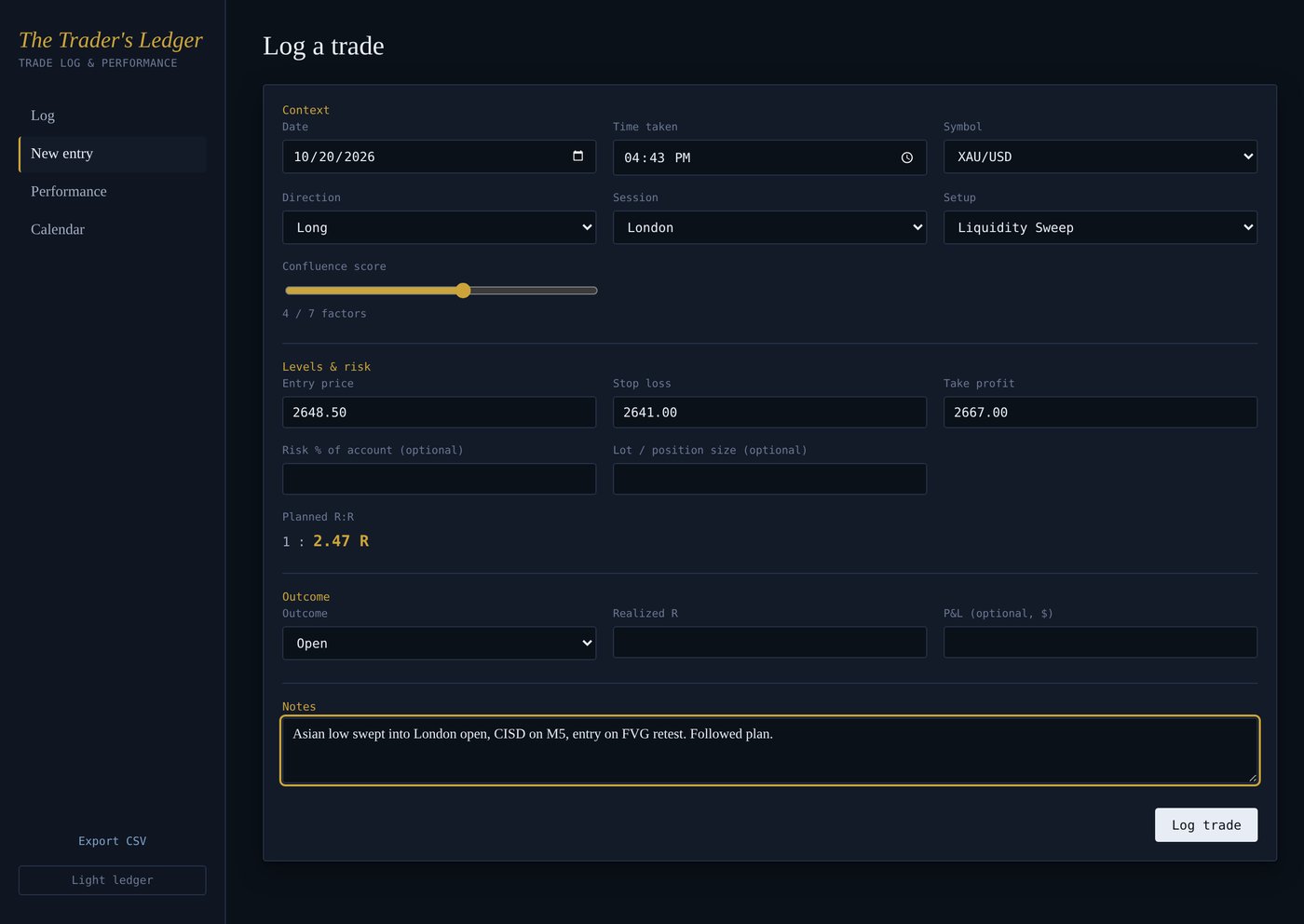
The Trader’s Ledger costs £19 once (the launch price until 31 December 2026, then £39). It runs in your browser with nothing to install and no account, puts the rules of 25 setups on screen, grades each trade before you take it and works out your lot size. Logging a trade takes about a minute.
A journal you pay for once, not every month
The Trader’s Ledger runs in your browser with nothing to install: 25 written setup cards, a pre-trade check that grades every trade A+ to Skip, lot sizes worked out for you, your stats by setup and session, and a free 49-page trading course. £19 once, the launch price until 31 December 2026, with a 14-day money-back guarantee.
See The Trader’s LedgerFrequently asked questions
What is the best free trading journal?
For most traders, a good spreadsheet template is the best free option, because it can show results by setup and session. Myfxbook is the best free choice for automatic MT4 and MT5 statistics.
Is Myfxbook a free trading journal?
Myfxbook’s core account statistics are free. It works best as an automatic statistics tool; setups and notes rely on you tagging trades yourself.
Is there a trading journal without a subscription?
Yes. The Trader’s Ledger is a one-off payment of £19 (the launch price until 31 December 2026), with no subscription and every future update included.
Do I need a paid trading journal?
Not to start. A free template is enough to build the habit. Paying makes sense when the free option is too slow or fiddly for you to keep using.
Educational content only, not financial advice. Trading carries a high level of risk and you can lose more than you expect. Examples use illustrative prices.