The forex trading journal: what to log, and how to turn it into an edge
A forex trading journal isn’t a list of trades. Your broker already keeps that. It’s a record of the decisions behind them: which setup, which session, how much you risked and whether you followed your plan. Kept properly, it tells you exactly where your edge is, and where your money leaks out.
What a forex journal should record
| Field | Why it matters for forex |
|---|---|
| Pair | You may trade GBP/USD well and EUR/JPY badly. You won’t know until you can sort by it. |
| Session | Asia, London, New York or the overlap. Most forex traders have one session that pays and one that costs. (Session times in UK time.) |
| Setup | The pattern you traded: a liquidity sweep, a London breakout, a pin bar. This is where the real insight is. |
| Entry, stop, target, exit | So the journal can work out your planned R:R and your result in R. |
| Risk | In pounds and as a % of the account. Lot sizes change from pair to pair; risk shouldn’t. (Pip value explained.) |
| News | Was there high-impact data within an hour? Trades into NFP or CPI behave differently. |
| Grade and rules | How good was the setup, and did you follow your plan? |
| Note | One line: why you took it, and one line: what you learned. |
An example entry
Setup: liquidity sweep of the London low · Grade: B (with the H1 trend, no FVG)
Entry 1.32150 · stop 1.32050 (10 pips) · target 1.32400 (2.5R) · risk £100 (1%)
Result: stopped out, −1R, −£100 · Followed plan: yes
Note: fine setup, US data 30 minutes later spiked through the stop. Next time, check the calendar and wait until after the release.
That loss is a good trade: it followed the plan and risked what it should. The lesson (check the calendar) is worth more than the £100. More in trading journal examples.
The weekly review (where the money is)
Logging is half the job. Every weekend, spend 20 minutes on these questions:
- Which setup made the most R this week? Which lost the most?
- Which session paid, and which didn’t?
- How many trades broke the plan, and what did they cost in R?
- Was there one mistake that repeated? Write one rule to stop it.
After 30 to 40 trades of each setup, the answers stop being noise. Keep the setups with a positive average R, drop the rest, and trade the sessions that suit you.
Where to keep it
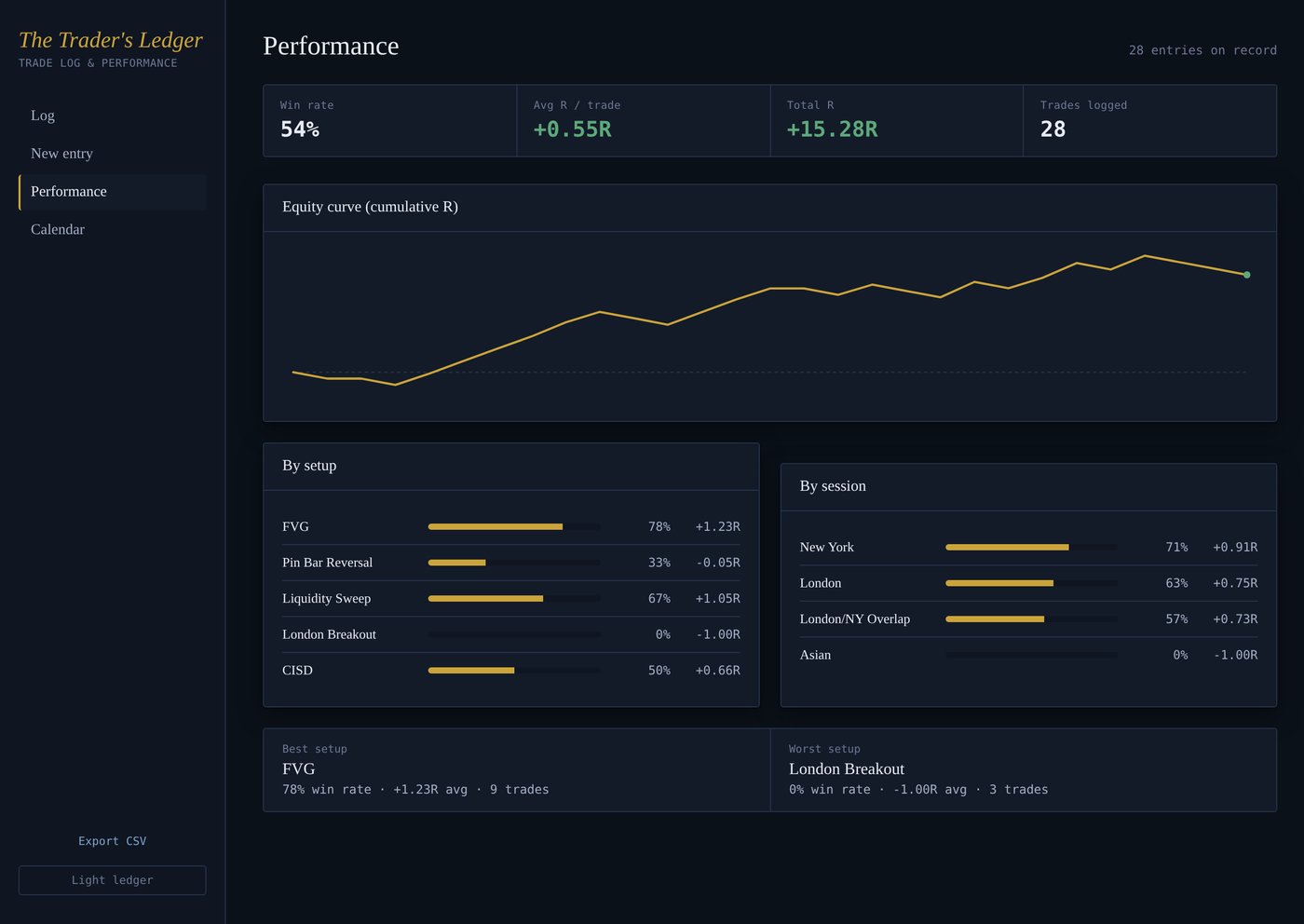
Start with the free forex trading journal template (Excel or Google Sheets). If you find the spreadsheet a chore, The Trader’s Ledger is built for exactly this kind of forex and gold journaling: sessions and kill zones built in, 25 written setups, lot sizes worked out for each pair, and your results by setup and session drawn for you.
A forex journal built for UK traders
The Trader’s Ledger runs in your browser with nothing to install: 25 written setup cards, a pre-trade check that grades every trade A+ to Skip, lot sizes worked out for you, your stats by setup and session, and a free 49-page trading course. £19 once, the launch price until 31 December 2026, with a 14-day money-back guarantee.
See The Trader’s LedgerFrequently asked questions
What should I write in a forex trading journal?
The pair, session, setup, entry, stop, target, exit, risk, result in R, whether there was news, a grade for the setup, whether you followed your plan, and a one-line note on why you took it and what you learned.
Does MT4 have a trading journal?
MT4 and MT5 record your trades in the History tab, but not your setup, session plan, reasons or rules. A journal adds that context.
How often should I review my forex journal?
Log each trade the same day, and review the week every weekend. Judge each setup after 30 to 40 trades rather than a handful.
Is there a free forex trading journal?
Yes. Our free trading journal template for Excel and Google Sheets works out your R, P/L and results by setup and session.
Educational content only, not financial advice. Trading carries a high level of risk and you can lose more than you expect. Examples use illustrative prices.