The Asian range strategy: how London sweeps it, and how to tell a sweep from a breakout
Overnight, while London sleeps, most markets drift in a tight range. Traders call it the Asian range. Then London opens, volume arrives, and one of the most repeatable patterns in intraday trading plays out: price runs one side of the Asian range, takes the stops sitting there, and very often turns and heads for the other side. Here’s how to trade it, and how not to get caught when it’s a real breakout instead.
What is the Asian range?
The high and low made during the Asian session. Definitions vary a little; a clean one for UK traders is 00:00 to 06:00 UK time. That window doesn’t move when the clocks change, which keeps things simple.
Two numbers matter: the high and the low. Above the high sit the stops of anyone short from the range and the buy orders of breakout traders. Below the low, the reverse. That’s liquidity, and London knows where it is.
Why London runs the Asian range
Big orders need someone on the other side. A large seller wants lots of buyers; a run above the Asian high triggers exactly that: breakout buys and short-stop buys. So a common London open is a push through one side of the range in the London kill zone, a stall, and a reversal. Not every day, but often enough to plan around.
Sweep or breakout? The rules
| Sweep (fade it) | Breakout (don’t fade it) | |
|---|---|---|
| The candle that ran the level | Closes back inside the range, often with a long wick | Closes beyond the level, with a solid body |
| The next candles | Fail to get back beyond the level | Hold beyond it; pullbacks stop at or near it |
| Lower timeframe | Structure shifts the other way (a CISD or change of character) | Structure keeps going the same way |
| Context | Against the higher-timeframe level being run (e.g. into resistance) | With the higher-timeframe trend, or on big news |
The one rule that saves the most money: wait for the close. A wick above the Asian high means nothing until the candle closes. Decide on the close, not on the spike.
A worked example on gold
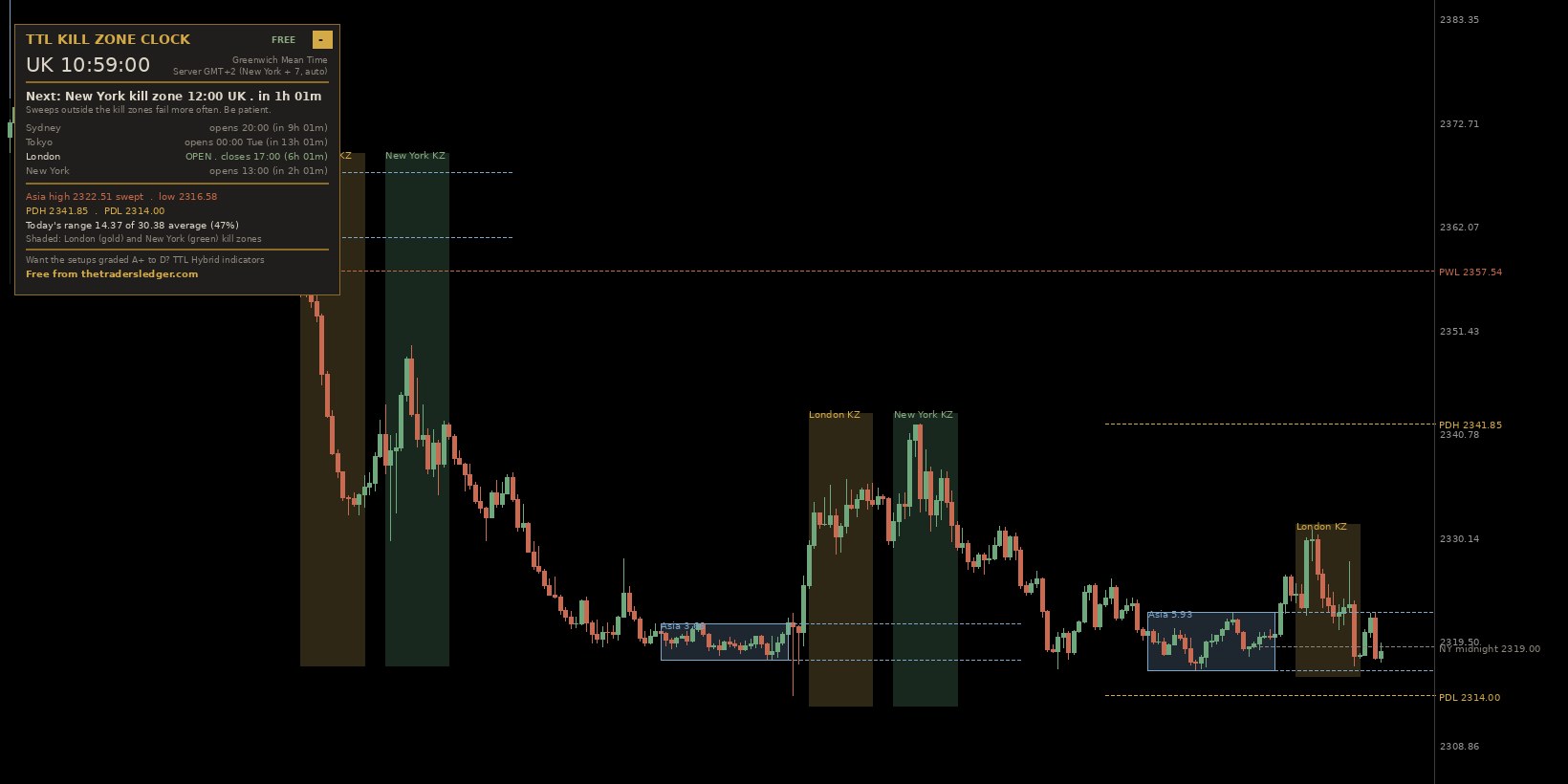
07:40 UK: price runs to 2322.51, above the Asian high. The M15 candle closes back at 2320.90, inside the range.
08:15 UK: M5 breaks its last higher low (the structure shift). Sell 2320.40.
Stop above the sweep high: 2322.90 (risk 2.50) · target the Asian low 2317.68 (1.1R), then yesterday’s low 2314.00 (2.6R)
The sweep took the stops above the Asian high, closed back inside, and the shift on M5 gave the entry. Size it so the 2.50 stop costs exactly what you planned to risk: use the free lot size calculator.
Five ways the Asian range trade goes wrong
- Trading it outside the kill zone. A sweep at 11:30 is far less reliable than one at 07:45.
- Fading every touch. If the candle closes beyond the level and holds, it’s a breakout. Step aside.
- Ignoring a huge range. If Asia already moved a full day’s average range, London has less to give. The Kill Zone Clock shows today’s range against the average for exactly this.
- Stops inside the sweep. The stop goes beyond the sweep’s extreme, not at the Asian high.
- News. If big UK or European data lands at 07:00 or 09:30, the first move can be pure noise. Check the calendar.
Get the Asian range drawn and alerted for you, free
The TTL Kill Zone Clock draws the Asian range, the London and New York kill zones in UK time, yesterday’s and last week’s highs and lows, with a live UK session clock and sweep alerts. Free for MT4 and MT5, and it handles the clock changes by itself.
Download the Kill Zone Clock freeFrequently asked questions
What time is the Asian range in UK time?
A common definition for UK traders is 00:00 to 06:00 UK time. Some traders use 19:00 to 00:00 New York time, but 00:00 to 06:00 UK is simple and doesn’t move when the clocks change.
Does London always break the Asian range?
No. London often runs one side of it in the first few hours, but some days it breaks out cleanly, some days it stays inside, and some days it runs both sides. Plan for the run, then let the candle closes tell you which it is.
How do you tell a liquidity sweep from a breakout?
Watch the close. A sweep runs the level and closes back inside the range; a breakout closes beyond it and holds. A structure shift the other way on a lower timeframe confirms the sweep.
Is there an Asian range indicator for MT4 and MT5?
Yes. The free TTL Kill Zone Clock boxes the Asian range with its size in pips, extends its high and low through London, and alerts you the first time either is run. Download it from thetradersledger.com/free/kill-zone-clock/.
Educational content only, not financial advice. Trading carries a high level of risk and you can lose more than you expect. Examples use illustrative prices.