What is CISD (change in state of delivery)? A simple explanation
CISD stands for change in state of delivery. It sounds complicated, but the idea is simple: it's the moment the candles stop pushing one way and start delivering price the other way. Traders use it as an early, precise trigger after a liquidity sweep.
CISD in one sentence
Find the last run of candles pushing into a high or low. When a candle closes beyond the open of that run, delivery has changed direction. That close is the CISD.
CISD vs break of structure
| CISD | Break of structure (BOS) | |
|---|---|---|
| What breaks | The open of the last run of opposing candles | The last swing high or low |
| Speed | Earlier | Later |
| Stop size | Tighter | Wider |
| Reliability | Fails more often | More confirmation |
Neither is “better”. CISD gets you in sooner with a smaller stop; a break of structure gives more confirmation at a worse price. Many traders use CISD in the kill zones and wait for a full break of structure at other times.
How to use CISD, step by step
- Bias first: know your higher-timeframe direction.
- Wait for a sweep of liquidity against that bias, for example the Asian low in a bullish market. (How liquidity sweeps work.)
- Mark the open of the last run of candles that pushed into the sweep.
- Enter on the candle that closes beyond it, or on a small pullback into it.
- Stop beyond the sweep extreme. Target the next liquidity in the new direction.
Where CISD fits with other smart money concepts
The classic sequence is: higher-timeframe bias, a sweep against it in a kill zone, a CISD back with the bias, then an entry at the CISD close or in the fair value gap the move leaves behind.
Measure your CISD trades
CISD is one of the 25 setup cards in The Trader’s Ledger, so you can see your real results for it by session. £19, one payment, with a free trading course.
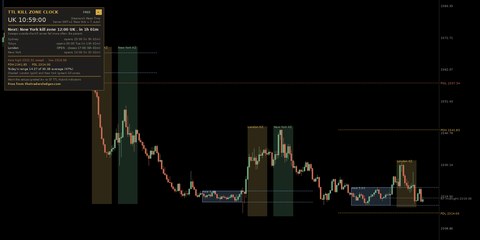
Get The Trader’s LedgerOn MetaTrader, TTL Smart Money Pro spots CISD after a sweep automatically, and tells you in its panel what it's waiting for.
Frequently asked questions
What does CISD mean in trading?
Change in state of delivery: the moment price closes beyond the open of the last run of opposing candles, showing delivery has switched direction.
Is CISD the same as a change of character (CHoCH)?
They're related but not the same. A CHoCH breaks a swing point; CISD breaks the open of the last run of candles, so it usually happens earlier.
What timeframe is CISD used on?
Usually M1 to M15 for the trigger, inside the London or New York kill zones, with bias from H1 to H4.
Educational content only, not financial advice. Trading carries a high level of risk and you can lose more than you expect. Examples use illustrative prices.